
What to expect from this article
Our guide will help you understand how under-sink solutions work, their pros and cons, the top companies, and how these filtration systems work for both small and large businesses with high or low water demand, and even homes. Our goal is to support you in the decision process by answering questions such as: Are the treatments all the same? Is it better to look for a whole-property solution for the entire building, or would point-of-use water filtration be ideal?
Read on for a full guide on under-sink water filtration systems in Canada.
Under-Sink Water Filters: What Businesses Should Know
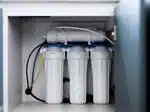
An under-sink system is where the water treatment happens. It is a point-of-use (POU) system installed beneath a sink and connected to one faucet. A useful solution when your business, regardless of the niche, segment, or size, needs high-quality drinking water delivered through a sink.
If you’re concerned about the water your collaborators and employees drink, how food is prepared, how customers are served, or what source a coffee machine uses, treating the entire building may be both pricey and unnecessary. For these lower-demand cases, such as smaller rooms (administrative offices, for example) and specific water demand needs, under-sink treatment can be useful.
For businesses (our focus here), water filtration is more complex than for residences, as the right system has to fit the volume of use (flow rate), the available space, the plumbing, the equipment connected to it, and be able to deliver according to the needs. Farms, labs, factories, hospitals, hotels… Each place have their particular requirements, so an under-sink filtration system is not a one-size-fits-all solution.
A restaurant, for example, might look for safe and high-quality water for drinking and food preparation, while a salon, a clinic, or a factory may have entirely different requirements.
Under-sink or whole building system? Not every business needs to filter every drop of water it uses. If the main concern is drinking water or water used for beverages and food preparation, point-of-use filtration can be a more convenient approach, as it allows the business to deliver drinking water exactly where it is essential.
According to Waterfilterlab, an effective metric to consider while making the decision would be matching the under-sink filter flow rate with the Gallons Per Minute (GPM) measurement. How is your water demand in GPM? Reviewing that can be a great start, as it defines how costly your under-sink system can be: It may range from $100 to more than $2,000, for example.
When Under-Sink Systems Make Sense for Businesses
Coffee shops, pharmacies, hotels, hospitals, and restaurants might look for this solution, as water for these cases is one of the main ingredients for everyone’s safety and health. For restaurants, for example, water can influence flavour, while minerals can contribute to scale buildup in espresso machines and other equipment, increasing equipment-maintenance needs. So the under-sink filtration system can not only improve water quality, but also prevent operational disruptions.
Businesses often have kitchens, and the point-of-use filtration might be useful in these cases, including service areas where employees and customers expect good-quality drinking water right away. For a typical office, as we said before, filtration may be primarily about employee comfort and drinking-water quality. It’s a convenient way to ensure everyone will be able to have high-quality water in their sink.
How to Track the Filtration Quality
In Canada, the Federal government specifies drinking water treatment standards, emphasizing that maintenance and knowing the manufacturer’s s operating parameters are important to keep treatment effective.
A useful tip for businesses is to have a person responsible for taking care of the treatment system to ensure its effectiveness and when it’s time for changes, replacements, or maintenance. Someone who knows when the cartridge was installed, when it needs replacement, which cartridge is required, whether replacement can be completed without disrupting operations, whether the system has a pressure or flow indicator, and is aware of what is needed if maintenance is missed.
The most common filtration technologies are:
- Activated carbon filtration – a technology that can improve taste and odour while reducing contaminants through adsorption. Depending on the certification, systems can target chlorine, chloramine and particular health-related contaminants.
- Sediment filtration – designed to capture suspended particles, and useful where water contains visible particles, rust or other sediment.
- Reverse osmosis – here, instead of relying primarily on adsorption or mechanical filtration, RO uses a semipermeable membrane to reduce a broad range of dissolved substances.
- Ultrafiltration – Known as “UF”, it sits somewhere between conventional filtration and reverse osmosis in terms of how it treats water. UF membranes have very small pores and can reduce suspended particles and certain microorganisms, depending on the system and its certification.
- UV Treatment – this technology uses light instead of chemicals. In summary, it is used to inactivate microorganisms as water passes through the treatment chamber, and can be useful in applications where microbiological control is a particular concern.
- Multi-Stage Systems – as the name suggests, the advantage is that each stage has a specific job, as a multi-stage under-sink system might combine sediment filtration, activated carbon, and RO, for example. As you can imagine, the downside is that it is more complex, and consequently operating costs are higher.
Certifications: One of the most important parts of evaluating a commercial filtration system
Since 1944, NSF has worked as an independent, internationally recognized organization dedicated to rigorous testing, auditing, and certification of an array of products and services. Their world-renowned staff of auditors, engineers, microbiologists, toxicologists, chemists, and public health experts provides services in 110 countries across all major industries. Therefore, having an NSF means a lot, but also knowing what your business is looking for is essential.
- NSF/ANSI 42, for example, addresses aesthetic effects, establishing minimum requirements for systems designed to reduce non-health-related contaminants (Chlorine, taste and odour, chloramine, particulate, iron, manganese, zinc, and total dissolved solids (TDS).
- NSF/ANSI 53 addresses specific health-effect contaminant reduction claims. This standard offers over 50 contaminant reduction claims. Some of the most popular include lead, Cryptosporidium, VOCs, and chromium.
- NSF/ANSI 58 includes requirements addressing various aspects of point-of-use (POU) reverse osmosis (RO) systems, including safety of materials in contact with drinking water (including content in accordance with NSF/ANSI/CAN 372), structural integrity, efficiency rating, contaminant reduction performance, and others.
Does your company aim to improve taste and odour, reduce chlorine or chloramine, reduce sediment or particulate matter, address a specific contaminant identified through water testing, protect coffee or food-service equipment from certain water-quality issues, or reduce dissolved solids? The objectives can be different for each industry, and there are distinct certificates for specific claims. For a business buyer, that difference matters.
Under-Sink Filtration Options for Large Businesses
Everpure
Features
Everpure
Everpure offers products to fit commercial kitchens needs to modern homes, bringing options with the Pure® Filtration Technology, and NSF-Certified for Safety & Performance to meet rigorous standards for contaminant reduction. Some of their products can be found in their Catalog here, as the Pentair Everpure H-300 Quick-Change Filter Cartridge, which filters 300 gallons – equivalent to 2,250 water bottles; or the Pentair Everpure H-104 Quick-Change Filter Cartridge, that delivers up to 1,000 gallons of purified water. Different options and features for different requirements.
In our article, we talked about many business types and needs. Everpure products and expertise in advanced filtration technologies have made the company the go-to choice for restaurants, cafes, homes, and even the aviation industry, as their products offer a wide range of water filtration systems designed to meet the unique demands of various industries.

Water Depot
Features
Ontario based, and 100% Canadian, Water Depot covers the province only offering a range of filtration products ideal for industries that reduce chemicals, iron, sediment, rust, stains, odour, bad tastes, cloudiness and more.
The company began in 1989, and quickly expanded throughout the Barrie area. Now, with over 35 locations across the province of Ontario, they offer services and products for businesses, and homes, providing water treatment experts who perform free water tests to determine which of our water treatment products are best suited to your situation. Some of their products include water Softeners, iron removal systems, reverse osmosis units, ultraviolet systems, in-store u-fill water station, filters and cartridges, and housings
According to their website, the company is one of the 110,000 members of the Canadian Federation of Independent Business (CFIB), a non-profit organization devoted to creating and supporting an environment where small businesses can succeed.

Excalibur Water Systems
Features
Excalibur reaches the whole country to offer its services and products, in addition to unlimited warranties in the industry, up to 20 years for residential equipment and 7 years for commercial & industrial equipment.
Their water filtration system fits a variety of commercial applications, and, according to their description, removes all contaminants, improves the taste and clarity of your water, removes unwanted odours in your water, provides pre-treatment for Reverse Osmosis Systems, turbidity filtration is as low as 1 micron and is self-cleaning – no replacement filters, and extends the lifespan of capital equipment.
According to Excalibur, it’s ideal for some niches, such as the food industry, hospitals, hotels, production assembly facilities, cooling towers, pharmaceutical, automotive manufacturing, and more.
Customer Information
Phone Number: 1 877-733-8999

Under-Sink Filtration Options for Lower Demand (Homes and Small Businesses)
It is important to check the water demand before making a deal, as these options below are for lower demand (home use). However, it might fit your business depending on the water needs (small office areas and a low number of employees).
Waterdrop
Features
Waterdrop has been committed since 2015 to develop innovative water purification technologies which are available today in more than 82 countries. Although recommended for home solutions, as every business has smaller rooms, and less demand depending on the sector, Waterdrop products and solutions can also fit these lower comnsumption cases.
Undersink, countertop, RO systems, and many other filter solutions are offered from the company, from electric to gravity fed water filter. According to Waterdrop, they are ranked as N.1 in Amazon water purification category, and has more than 300 patents. Another curiosity is that in 2024, their X16 RO system had the fastest water flow rate among water purifiers that are against NSF 58 standard certification by NSF or IAMPO or WQA agencies.

Culligan
Features
Culligan is known across the country as one of the best household names in water facilities and businesses. They handle everything from filtration systems to ice and water dispensers and under-sink products.
Their under-sink system is compact and can be installed in various locations, as long as there’s access to a cold water line and drain. According to Culligan, the AC-30 Good Water Machine offers a powerful four-stage filtration and an optional water quality monitor in the faucet. The reverse osmosis water filter system provides great value and a high-quality hydration experience.

Aquarenaissance
Features
Founded in 2008, Aquarenaissance brings over forty years of expertise in water filtration and marine conservation. 100% Canadian-owned company, they manufacture and assemble many of their products locally, which allows them to maintain quality standards and to support customers when needed.
Regarding filtration, the company offers the PR110 product, an advanced 10-inch water filter cartridge, engineered for high-performance removal of chloramine and heavy metals. According to Aquarenaissance, it is 100% NSF-certified catalytic carbon and an innovative filtration technology, removing even challenging contaminants such as chloramine, lead, ammonia, arsenic, volatile organic compounds (VOCs), and hydrogen sulphide.
Designed for standard under-sink filter housings, PR110 also offers hassle-free installation. Some product features are:
- Chlorine, Chloramine & Ammonia Removal
- Made with Certified Catalytic Carbon
- Excellent Taste & Odour Removal
- Specialized Heavy Metal Removal Media
- Certified by IAPMO to NSF/ANSI 42
- Removes Lead, Iron & Mercury
- Removes Arsenic and Hydrogen Sulphide
- 5 Micron Absolute Sediment Removal
- MADE IN CANADA
- High flow rate

Aquasana
Features
Reverse osmosis, under-sink, countertop… Aquasana offers plenty of filter solutions for those looking for low-water-demand products. The company believes that clean water and a healthy environment are the most important components of healthy living, and decreasing water bottle consumption is a way to be more sustainable.
To guarantee water is pure and follows quality standards, Aquasana uses award-winning filtration technology designed by expert engineers that provides maximum contaminant reduction while leaving beneficial minerals such as calcium, magnesium, and potassium in the water. Also, according to the company, their product components are engineered for minimal waste, including reusable outer filter casings and filter cartridges made of recyclable parts and compostable materials.
Regarding some of its products, their reverse osmosis system removes up to 99.99% of 90 contaminants, including fluoride, arsenic, chlorine, and lead. Same for the under-sink solution, which is award-winning, and filters remove up to 99.99% of 78 contaminants. Same quality for the countertop option.
Customer Information
Phone Number: 866-662-6885

Pros and Cons of Under-Sink Water Filtration Systems
An under-sink filtration system can be a smart investment, but it isn’t necessarily the right answer for every business or household. The biggest advantage is that it treats water where it is actually needed, and knowing the pros and cons can help you make the decision:
Pros
- It is possible to filter water at the specific sink where drinking, food preparation, coffee making, or any place where water quality is essential.
- Most units assemble underneath the existing sink, keeping the filtration equipment out of view and keeping the space free.
- Depending on the filtration system, it might be able to reduce chlorine, sediment, and other substances that affect taste and odour. Many brands we talked about have this characteristic described in their products.
- Businesses may be able to reduce their dependence on bottled water, so that is also a sustainable solution.
- Coffee shops, restaurants, offices, hotels, hospitals, pharmaceuticals, and many other business types can benefit when water quality directly affects beverages or food preparation.
- It is an affordable solution, as if only one or two points of use require treated water, a point-of-use system may avoid the expense of treating water that the business doesn’t actually need to filter.
- Businesses can choose among different technologies including carbon filtration, ultrafiltration, and reverse osmosis, depending on the water-quality challenge and application.
Cons
- An under-sink system only addresses the water connected to it, so consequently it is different than the whole filter solution. If a business needs filtration throughout the property, a centralized system may make more sense.
- The equipment itself is only part of the expense, which means plumbing modifications, professional installation, additional faucets, pumps, or other components can increase the initial investment.
- The area underneath a commercial sink may already be crowded with plumbing, cleaning supplies, waste containers, or other equipment. The under-sink system requires this free space.
- Not every filter removes the same contaminants, and that is an important distinction. A carbon filter, RO membrane, UV system, and ultrafiltration system perform very different jobs, so your business needs to understand its specific needs.
- It requires proper research. Choosing the company/product according to the demand is essential, as a system designed for a small office may not be able to keep up with a busy restaurant or café. Water flow matters, and we highlight that commercial users must consider peak demand, not just average daily consumption.
- Replacement filters, maintenance, service calls, electricity for certain systems, and potential wastewater costs can make the long-term price considerably higher than the initial purchase price, and that is essential to keep water quality.
What You Should Know About Under-Sink Water Filtration Systems
What is an under-sink water filtration system?
An under-sink water filtration system is installed beneath a sink and connects directly to the water supply. Instead of filtering water throughout an entire building, it treats the water at a specific point of use, typically where drinking water, coffee, food preparation, or other higher-quality water is needed.
For which businesses are under-sink water filters ideal?
They can be particularly practical for businesses that need better-quality water at specific locations without investing in a whole-building filtration system. Offices, cafés, restaurants, salons, clinics, hospitality businesses, and other commercial spaces may use them depending on their water requirements. Some companies we presented above even provide indications regarding products and ideal business niches.
How often do commercial under-sink filters need to be replaced?
There isn’t one universal replacement schedule. Filter life depends on the filter type, water quality, usage volume, and manufacturer specifications. A busy café, for example, may go through a cartridge much faster than a small office with relatively low water consumption. A neglected filter can become less effective and may eventually restrict water flow. That’s why filter replacement shouldn’t be treated as an optional maintenance task. Businesses should follow the manufacturer’s recommended replacement interval and pay attention to changes in flow, taste, odour, or system performance.
Do under-sink filters require electricity?
Many basic filtration systems do not require electricity; however, more advanced systems may require a power connection.
How do I know which under-sink filtration system my house or business needs?
Start with the water, not the product. For what do you need it? What would be the water demand? Which type of water flow is needed? Consider the source of the water, the contaminants or minerals you want to reduce, daily water consumption, available space, plumbing configuration, and the intended use of the filtered water. A water-quality test can also help determine whether a basic carbon filter, ultrafiltration, reverse osmosis, or another technology makes sense.
Commercial water solutions and guidance
Looking to reduce your water costs? Check our Water Hub, which covers a wide range of water efficiency tips for both homes and businesses. EnergyRates.ca can also help you review and reduce your utility costs beyond water usage. Our experienced team of energy consultants can support you in comparing plans for your commercial, large commercial or industrial operations.
In addition to lower bills, EnergyRates.ca can also help businesses with corporate sustainability solutions, including Carbon Accounting, RECs and Carbon Offsets, and VPPA information.
Contact us or call us at 1-855-635-9608 for a custom quote based on your energy needs.