
In this article:
- How often gas meters are read and how estimates are used in Ontario.
- Locating your gas meter in your home.
- Reading digital gas meters.
- Reading dial (analog) gas meters.
- What to do if you think your bill is inaccurate.
Regardless of who you buy your natural gas from in Ontario, your local gas utility is responsible for reading your meter. These readings are typically scheduled every 1 to 2 months, depending on the utility and meter type, with billings sometimes based upon estimates of expected consumption. In some cases, smart meters may allow for remote readings. Your gas bill should indicate whether you were billed according to estimates or actual meter readings.
It is advisable to learn how to read your meter, so you would be able to determine whether or not you are being accurately billed. If an error is made, you can notify your gas distributor or submit your own meter reading, and any necessary adjustments will typically be reflected on a subsequent bill.
Locate Your Meter
Gas meters are typically located outside your home, off to the side where a meter reader can easily access it. However, this location can vary, and in some homes the meter may be located indoors (such as in a basement or utility room). If you are unable to find it, contact your distributor for assistance.
Reading Digital Gas Meters
Many gas meters display gas consumption in a digital format, using either an electronic display similar to a digital clock, or a mechanical display like the one below.
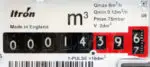
Reading a meter like this is self-explanatory. In this case, the reading would be 14.396 cubic meters (or another unit such as cubic feet, depending on the meter).
Reading Dial Gas Meters
Gas meters that use dials (sometimes referred to as imperial style) can be a little more daunting for the uninitiated. But if you can read an analog clock, then you can read a dial meter. This is an example of one:

The meter pictured is a little unusual in that not all the dials turn clockwise. The arrows indicate which direction they turn. But the idea is still the same as looking at the hour hand on a clock face: if the hand is pointing directly at a number or has moved past it, then that is the number to note. If the hand is almost to that number, but not quite, then the previous number is what the dial is indicating. If a hand is exactly on a number, you may need to check the dial to the right to confirm the reading.
In the case of the meter dials pictured above, the reading would be 7,205. The numbers over the dials are used by the utility to interpret the reading and calculate usage.
If you would like to learn more about reading this style of gas meter (and even take a quiz to test your knowledge), check out our blog post about reading old-style dial meters. The blog post goes into more technical detail and even teaches you how to calculate your usage since the last reading.
Key takeaways:
- Your local utility (e.g., Enbridge Gas) reads your gas meter, even if you buy gas from a retailer.
- Meter readings are typically taken every 1–2 months, while smart meters may allow more frequent or remote readings.
- Gas meters are usually located outside but may also be found indoors in some homes.
- Learning to read your meter can help you spot potential billing issues.