
Everything you need to know about the Rate of Last Resort
The Rate of Last Resort (RoLR) is the default electricity plan in Alberta for consumers who aren’t under a competitive retail contract. It became effective as of January 2025, and will remain the same until December 31st, 2026, working as a two-year fixed rate.
Every two years, the rate is reviewed by the Alberta Utilities Commission (AUC) and may be increased or decreased by up to 10%.
RoLR rates for 2025 and 2026
| EPCOR | ENMAX | Direct Energy Regulated Services | |
| 2025-2026 Term | 12.01 ¢/kWh | 12.06 ¢/kWh | 12.02 ¢/kWh |
How the RoLR Rates Are Determined
This regulated electricity rate is known as the RoLR or Rate of Last Resort. “Regulated” does not mean that the RoLR price is set by the government of Alberta. Instead, the RoLR rate is determined by an independent organization, the Alberta Utilities Commission (AUC), which functions independently from the government. The AUC’s mandate is to act impartially, treating both electricity suppliers and their customers fairly. The RoLR price set by the AUC is meant to fairly compensate energy providers while also ensuring that customers pay a fair and reasonable price.
The AUC calculates the Rate of Last Resort based on the current market price of electricity in Alberta and how the price is expected to change. The RoLR is also based on global market conditions (which can be affected by weather, supply and demand, and a host of other factors) and the cost of transmitting electricity to various parts of the province.
The RoLR is set and published by the AUC every two years on the first business day of December. For example, the Rate of Last Resort for the 2025-2026 term was announced on December 2nd, 2024, and became effective as of January 1st, 2025. Unique jurisdictions, like Medicine Hat, for example, maintained the ability to set their own prices under their own schedule.
Before the name change, RRO rates changed monthly.
When will the Rate of Last Resort change?
The RoLR changes every two years. The current term ends on December 31, 2026, and the next one starts as of January 1, 2027 and ends on December 31, 2028.
RoRL Providers
In Alberta, there are four RoRL providers for electricity for residential and small business consumers. They are:
- Direct Energy Regulated Services
- ENMAX Energy
- EPCOR Energy (Edmonton)
- EPCOR Energy (surrounding Edmonton area)
Check out our page on Rate of Last Resort providers in Alberta to learn more.
Am I eligible for the Rate of Last Resort?
To be eligible for the RoRL, customers must be:
- A residential or farm and irrigation customer.
- Be a small business or commercial operation that uses less than 250,000 kWh of electricity per year.
- Be 16 years of age or older.
To sign up for the Rate of Last Resort, submit your name, phone number, mailing and/or legal address, and the date you require service to your chosen provider. As we noted earlier, customers who do not sign an energy contract with a competitive retailer are signed onto the RoLR by default.
Predicting RoLR Prices
The Rate of Last Resort is set every two years by the Alberta Utilities Commission (AUC). RoLR rates can be adjusted up or down by a maximum of 10% every new term. Based on the current prices (2025-26), the Rate of Last Resort for the next term (2027-2028) will likely be between 10.80 cents/kWh and about 13.20 cents/kWh.
How the Rate of Last Resort compares to competitive rates
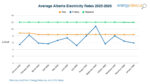
So far, the rate of last resort (ROLR) has been higher than most of the floating and fixed rates available in Alberta. For example, the floating electricity average (¢5.922/kWh) in January 2026 was 67% lower than the RoLR average.
Average fixed electricity rates were also significantly lower than the rate of last resort in January 2026, about 43.18%. Comparing the RoLR to the lowest fixed rate available that month (7.99 cents/kWh), the difference is even wider: 50.5%.
With the change from monthly set rates to two-year terms, ROLR prices could be more stable than in the 2010-2024 period, but not necessarily lower than the competitive energy options, be it fixed or floating rates.
The chart below details demonstrates how the Rate of Last Resort was considerably higher than all retail energy plans from January 2025 to January 2026:
How to leave the RoLR for a lower energy rate?
RoLR customers are allowed to leave their plans anytime without any exit fees.
In Alberta’s deregulated energy market, consumers can compare energy rates and choose a new provider. Once you’ve reviewed your options and selected an electricity plan of your preference, all you have to do is sign up with the new retailer. They will take care of transitioning your power services without interruptions.
For a full guide on how to switch from the Rate of Last Resort to a competitive option, check our tutorial article here.
What if I have poor credit?
The RoLR was designed as a last resort, or a safety net, for all eligible consumers in Alberta who can’t sign up for a competitive retailer, including people with adverse credit history. Although the province incentivizes Albertans to explore their options and potentially leave the Rate of Last Resort, it understands that there should be a default regulated rate option for consumers.
This means that if you can’t pass a credit check with a competitive energy retailer, you are on the Rate of Last Resort.
Are there any additional fees with the Rate of Last Resort?
Yes, the RoLR contains a 0.1 cents/kWh charge. This fee is used for consumer awareness campaigns by the Utilities Consumer Advocate (UCA), including phone calls, energy bill notices, and other types of advertisement. The plan is to provide Albertans with more clarity and incentivize consumers to compare their energy options.
There may also be occasional RoLR-specific temporary rate riders, like it happened in July 2025 and January 2026. These are usually applied by the provincial government to recover the costs of implementing changes to the regulated rate system. These costs are shared amongst all RoLR customers.
Pros and Cons of the RoLR
Advantages of the Rate of Last Resort
- Flexibility: The RoLR does not lock customers into a set energy contract. Consumers are free to leave the plan at any time. However, this became less of a unique feature over time, as most energy retailers in Alberta today let customers leave their plans without any penalties by giving 10 or 15 days’ notice.
- No exit fees: The RoLR does not charge any penalty fees for plan cancellation. However, this is not exclusive to the RoLR.
- No credit check: Because it is the default option, all consumers are eligible for the RoLR regardless of their credit score.
Disadvantages of the Rate of Last Resort
- Higher prices: Because it is a rate of last resort, prices may not always be the most advantageous, as the province sees it as a way of incentivizing competition and encouraging customers to leave the regulated option. So chances are high that Albertans can find more stable rates (like longer terms) at lower levels with fixed-rate energy providers, or lower floating rates if the market rate is low. This could put pressure on small businesses and low-income families if they are on a tight budget.
- Additional fees: In addition to the 0.1 cents/kWh consumer awareness charge, RoLR consumer may also face other RoLR-specific, occasional charges, such as the previous temporary rate riders charged in 2025. As more customers leave the RoLR, the burden of such costs may even increase, since fewer consumers remain to share them.
How do I know if I’m on the Rate of Last Resort?
The are two easy ways to find out if you’re under the RoLR:
- Check your energy bill for any mentions of “RoLR” or “Rate of Last Resort” under the electricity charges section.
- You can also check your energy bill for any mentions under the electricity charges section to one of the RoLR providers: Direct Energy Regulated Services, EPCOR Rate of Last Resort, or ENMAX Rate of Last Resort.
How many people are on the Rate of Last Resort?
According to UCA Helps data, about 26% of residential consumers, 29% of commercial consumers, and 40% of farm customers get their electricity via the RoLR.
RRO vs RoLR: The difference between monthly and two-year rates
In 2006, the AUC started incorporating data on short-term projections into the RRO calculations. In 2010, the default rate became entirely based on price projections for the month ahead.
The consequence of recalculating the RRO on a month-to-month basis was that the price of electricity changed often, and sometimes by a great deal. This was good when sudden jumps in supply or decreases in demand quickly lowered electricity bills. However, market volatility can make it very difficult to plan out a budget. In May 2007, for instance, the RRO price of electricity for Direct Energy Regulated Services customers was 7.591¢/kWh. The price then rose for the next four months, reaching a peak of 11.673¢/kWh. This means that if a customer’s electricity bill was $100 in May, by September they were paying $153.77 for the exact same amount of electricity.
This increase may not have been dire for most residents of Alberta, but the RRO rate for businesses was nearly identical to that for residential customers. A business that used 200,000 kWh per year, if its usage was identical from month to month, would have gone from paying $1,283 in May, to $1,949.67. A change of a little less than $700 might not have affected many businesses, but for an owner who was running a tight budget, the sudden increase might have proved a bit problematic.
In 2022, RRO prices in the Edmonton region fluctuated from 10.702¢/kWh to 24.208¢/kWh, and from 9.971¢/kWh to 22.133¢/kWh in Calgary. In July 2023, the RRO rate reached 27.575¢/kWh in Calgary, a 73.07% increase from the previous year. The RRO rate in Edmonton hit 28.024¢/kWh in July 2023. This was an 85.6% increase from the previous year. The high RRO rates were attributed to high electricity usage and the deferred RRO repayment.
The following were the RRO prices for 2024:
EPCOR (Edmonton) | ENMAX (Calgary) | Direct Energy Regulated Services | |
January | 19.55 ¢/kWh | 18.16 ¢/kWh | 19.39 ¢/kWh |
February | 18.932 ¢/kWh | 17.686 ¢/kWh | 18.685 ¢/kWh |
March | 13.175 ¢/kWh | 13.07 ¢/kWh | 13.376 ¢/kWh |
April | 14.692 ¢/kWh | 12.814 ¢/kWh | 14.457 ¢/kWh |
May | 10.845 ¢/kWh | 9.618 ¢/kWh | 10.801 ¢/kWh |
June | 11.61 ¢/kWh | 10.473 ¢/kWh | 11.402 ¢/kWh |
July | 12.076 ¢/kWh | 11.044 ¢/kWh | 12.245 ¢/kWh |
August | 13.59 ¢/kWh | 12.341 ¢/kWh | 13.384 ¢/kWh |
September | 11.698 ¢/kWh | 10.123 ¢/kWh | 11.361 ¢/kWh |
October | 10.829 ¢/kWh | 9.264 ¢/kWh | 10.392 ¢/kWh |
November | 10.508 ¢/kWh | 9.907 ¢/kWh | 10.455 ¢/kWh |
December | 12.004 ¢/kWh | 10.974 ¢/kWh | 11.842 ¢/kWh |
The following were the RRO prices for 2023:
EPCOR (Edmonton) | ENMAX (Calgary) | Direct Energy Regulated Services | |
January | 13.5 rate cap (29.476 ¢/kWh) | 13.5 rate cap (29.112 ¢/kWh) | 13.5 rate cap (26.996 ¢/kWh) |
February | 13.5 rate cap (32.957 ¢/kWh) | 13.5 rate cap (29.677 ¢/kWh) | 13.5 rate cap (32.672 ¢/kWh) |
March | 13.5 rate cap (20.022 ¢/kWh) | 13.5 rate cap (18.681 ¢/kWh) | 13.5 rate cap (21,894 ¢/kWh) |
April | 17.734 ¢/kWh | 17.622 ¢/kWh | 20.134 ¢/kWh |
May | 16.829 ¢/kWh | 16.007 ¢/kWh | 16.779 ¢/kWh |
June | 18.956 ¢/kWh | 18.231 ¢/kWh | 17.620 ¢/kWh |
July | 28.024 ¢/kWh | 27.575 ¢/kWh | 26.578 ¢/kWh |
August | 32.539 ¢/kWh | 31.858 ¢/kWh | 32.425 ¢/kWh |
September | 27.759 ¢/kWh | 26.455 ¢/kWh | 28.880 ¢/kWh |
October | 19.691 ¢/kWh | 18.897 ¢/kWh | 20.484 ¢/kWh |
November | 19.565 ¢/kWh | 18.623 ¢/kWh | 19.836 ¢/kWh |
December | 20.863 ¢/kWh | 19.356 ¢/kWh | 20.716 ¢/kWh |
These sorts of concerns are why the competitive retail electricity market exists today.
It may well be that staying with your default regulated supplier of electricity is the optimal solution for you, but there’s no reason not to investigate the competitive retail alternatives to paying the ROLR price for electricity or natural gas. Everyone has the right to choose the solution that suits them best.
The History of the Regulated Rate Option in Alberta
Starting in 2001, customers gained access to retailer-provided electricity, thanks to the process of deregulation that began in 1996 with the passage of the Electric Utilities Act the previous year. In the past, businesses and residents were simply stuck with paying the going rate to whichever utility operated in their area. The passage of the EUA changed this. Customers gained the ability to choose their electricity retailer, based upon their personal preferences for price, price stability, service quality and other attributes.
However, it made sense to provide a safety net, to make sure there was a baseline price in place for businesses and residents to fall back on in the case of high retail electricity rates, low credit scores, or other unanticipated problems. All areas of Alberta still have a designated energy provider for each geographic area that provides electricity at regulated rates. When someone chooses not to sign up with an electricity retailer, they automatically get their electricity from — and pay their bills to — that default utility company. Any business or residence that uses less than 250,000 kWh per year can choose to pay the regulated rate.
In 2024, the Alberta government renamed this plan from RRO to Rate of Last Resort (RoLR). The reasoning behind the name change was to encourage consumers to explore competitive retail energy options and inform them that the regulated rate isn’t necessarily a safety net when rates are high. As of January 1st, 2025, all RoLR providers were required to remind customers of their energy rate options on their monthly bills.