
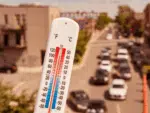
When we moved to Alberta in 2018, most people we talked to did not see the need for an air conditioning system in their homes. Summers were consistently temperate, meaning that a few days of heat above 30 °C were easier to tolerate, knowing that for the rest of the season, we would not be hiding in a basement or closing our blinds during the day. However, over the last few years, temperatures have shifted from moderate to consistently above average, and last summer we installed an AC unit, calling it “the best decision we ever made.” In fact, the AC ran constantly, even throughout the September heat waves.
Cities across Canada have broken daily heat records, surpassing their normal number of days above 30 °C. According to Environment and Climate Change Canada (ECCC), Canada has not seen a year as hot as 2023 since at least 1940.
In August 2023, British Columbia recorded the summer’s hottest temperature of 42.2 °C, which resulted in a jump in electricity consumption. The same summer, the province of British Columbia used 7.7% more electricity than the July average from 2016 to 2020.
On the other side of the country, Halifax, Montreal, and Toronto areas have broken roughly fifty-one daily heat records, recording mid-30s °C temperatures. Overall, dry conditions in Canada have persisted for years. For instance, in the current summer of 2025, several regions (including central British Columbia, northern Alberta and Saskatchewan, Manitoba, parts of northwest and eastern Ontario, and southern Quebec) received less than half the expected rainfall.
The extreme heat, which is more expected than occasional, impacts quality of life, healthcare systems, and is one of the main reasons for annual wildfires. According to experts from the World Weather Attribution, the cumulative severity of Quebec’s fire season in 2023 was at least fifty percent more intense than previous years and at least seven times more likely to occur.
Besides impacting climate and health, regular heatwaves cause disruption to electricity grids. The escalating strain on the energy network affects grid transmission, cooling systems, and overall efficiency of energy generation, which in turn has a noticeable impact on households, schools, small businesses, and especially establishments that operate on a lower budget.
Foresight Canada predicts that without resolute actions, energy systems will face continuous instability, and infrastructure failures will continue. In The Hidden Costs of Heatwaves, they state that Canada’s manufacturing sector alone could see annual losses of $1–2 billion by 2050 due to the productivity impacts of heat waves on the workforce ($3.2).
Hot Weather Demand on the Electricity Grid
Electricity use continues to rise as the weather heats up. Cooling systems, such as air conditioners, refrigerators, and fans, have to run longer to keep indoors comfortably cool. Considering the increasing demand for AC units, the extra strain on the electricity grid is inevitable. In provinces with a deregulated market (Alberta) and partially deregulated markets (Ontario), it leads to higher wholesale electricity prices.
Additionally, the energy grid faces decreased energy production and reduced transmission efficiency. That happens because turbines can become up to 25% less efficient in higher temperatures. When temperatures rise, the transmission lines lose up to 5.8% of their capacity to carry electricity, which makes it harder for the grid to meet growing demand and results in service disruptions and a slowed-down energy cycle.
The Effect of Heatwaves on Your Electricity Plan
While in most provinces electricity is provided by a government-owned company, in Alberta, the market is mostly deregulated. Customers can choose between a competitive retailer or a regulated default rate (Rate of Last Resort) that is set by the Alberta Utilities Commission.
The customers who choose a variable-rate plan will find their rates tied directly to the market price. During summer heatwaves, wildfire-related grid stresses, those rates might increase depending on the market conditions. Meanwhile, customers with a fixed-rate plan will continue to pay the locked-in rate even during periods of high demand.
Preparing for Extreme Heatwaves
On the provincial levels, those measures do not rely solely on active cooling (reliant on energy consumption), but also encourage passive cooling that does not depend on electricity and can help to save money on energy bills.
In What is Climate Action, and What Does It Mean for Businesses?, we mentioned that even if the Government of Canada offers certain solutions for climate action, it does not mean that businesses will pursue equal measures. However, a rising number of businesses are developing and embracing new technologies, products, and services that mitigate climate change.
The measures to prepare for heatwaves often include:
- Planting more trees and green roofs in urban areas to create enough shade.
- Installing indoor cooling devices.
- Providing the public with relatable information on how to stay safe during heatwaves, including sending heat warnings.
- Designing city infrastructure to withstand extreme weather conditions, including renovations to existing infrastructure (enhancing insulation and airtightness.)
- Encouraging the public to behavioural changes during heatwaves, such as ventilating buildings properly at night, minimizing waste indoor heat production, and closing drapes or blinds during peak hours.
Managing Electricity Use During Heatwaves
By making a few simple adjustments to our habits, we can reduce both electricity costs and demand on the grid, especially during peak times (including heatwaves and wildfire seasons):
- Installing blinds and closing curtains during the hottest part of the day to prevent constant overheating of the rooms (especially South-facing rooms.)
- Running fans more often than turning on the AC unit.
- Using major appliances such as laundry machines and dishwashers in the evening or early morning.
- In How Extreme Cold Affects Your Energy Bills in Winter, we mentioned that energy is a commodity whose price goes up with the rising demand. To reduce energy use and adjust your demand, we also recommend finding out peak hours for your area and doing laundry or running a dishwasher during times when “everyone else on the grid does not have the same idea.”
- Besides those common methods of staying cool without an AC, we also mentioned the Egyptian Method, which requires sleeping underneath a blanket previously soaked in water. “As they (Egyptian ancestors) slept, the water would evaporate throughout the night, leaving them sleeping cool.” If you want to try this, soak your blanket in the bathtub, or skip the dryer cycle after giving your sheets a quick wash.
Temperature spikes and wildfires are defining factors in how electricity is priced and delivered across provinces.
To prevent spending too much on electricity bills, we recommend comparing energy providers and their rates. The more energy plans you compare, the higher the chances of locking in at a low rate.
At EnergyRates.ca, we can assist you in comparing electricity and natural gas rates in Alberta, Ontario, Saskatchewan, British Columbia, Québec, and Manitoba. Our website is free and impartial in listing the major energy suppliers in each province and providing an overview of available energy rates.
Whether commercial, large commercial and industrial, and natural gas consumers, to find out if you could be paying less even during summer heat spikes, start by filling out the form above.