
Choosing the right electricity plan for your EV in Ontario

Launched in 2023 to help people who use more electricity at night for any reason, such as shift workers or those who charge their electric vehicle later, the Ultra-Low-Overnight (ULO) plan was created to help such consumers save up to $90 per year (or more). This works as an extra option that fits Ontario residents with more specific routines or needs.
Although volatile, as in 2024 ZEV shares reached new heights, making up 14% of new annual sales, the EV market changed consumer behaviour not only on the roads, but also at home (with additional energy consumption used for charging). This represents a new category of electricity demand, which also requires more flexibility and adjustments to the electricity consumption options. That was one of the reasons the Ontario Energy Board developed the ULO. The idea was to adapt residential pricing to different realities.
Electric Vehicles and Ultra-Low Overnight
In fact, EV charging naturally fits into overnight hours, as it makes plenty of sense to charge the vehicle while you rest during the night. For many residents, and maybe the majority of EV owners, plugging the vehicle before bed and waking up to a full battery became the new normal. That is where the connection between EV owners and ULO plans reinforces itself.
Under ULO, electricity prices are divided into four time periods:
- Ultra-low overnight Every Day, 11 pm to 7 am: ~3.9 ¢/kWh;
- Off-peak. Weekends and holidays, 7 am to 11 pm: ~9.8 ¢/kWh;
- Mid-peak. Weekdays, 7 am to 4 pm and 9 pm to 11 pm: ~15.7 ¢/kWh;
- On-peak. Weekdays, 4 pm to 9 pm: ~39.1 ¢/kWh.
Households that adopted electric vehicles found themselves benefiting from the structure, and we will better explain it soon by comparing other plans in Ontario. The point is that the ULO is no longer just an alternative billing option, as, depending on the routine and electricity use at home or business, it may also be the best one.
Get unbiased information
Add EnergyRates.ca as a Preferred Source on Google to see more of our articles in your search results.
For many families, this shift is subtle. But for EV owners, it can mean the difference between a modest monthly charging cost and one that is almost negligible compared to gasoline. Come to check the graphic we created comparing Time-Of-Use (TOU) and ULO, both at On- and Off-Peak hours, to illustrate what we are talking about:
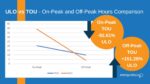
Ontario Electricity Plan Options vs Ultra-Low Overnight
For a deeper comparison by checking all rates and possibilities, in the Time-of-Use (TOU) plan residents face in the summer:
- On-peak. Weekdays 7 am to 11 am and 5 pm to 7 pm: 20.3¢/kWh;
- Mid-peak. Weekdays 11 am to 5 pm: 15.7¢/kWh;
- Off-peak. Weekdays 7 pm to 7 am; weekends and holidays all day: drops to 9.8¢/kWh.
For the third option in Ontario, Tiered (a set amount per month) can be the right option if the person or business is 100% aware of their energy use and can control it. Here, electricity prices remain constant during the day but change if more than a certain set amount of electricity is used. For residents, the first 600 kWh/month is around 12.0 ¢/kWh, and if they go above the set amount, 14.2¢/kWh. On the official OEB page, users can check the latest rates and their schedule.
Is the Ultra-Low Overnight (ULO) the Best Option?
Not necessarily. When it comes to energy, it is almost impossible to definitively say that one plan is better than another. If using electricity overnight is an option and a constant habit at home, ULO may be the most affordable plan to choose — especially if we consider the difference we saw on the graphic above.
However, if the energy is required during the day for dishwashing, working from home, or even recharging your EV, the Time-of-Use plan is probably the most suitable plan. That is because although the overnight rate is designed to be the cheapest electricity window available to residential customers in Ontario, the on-peak hours rates in ULO are almost 93% higher than those in TOU.
More than a pricing plan, the Ultra-Low Overnight reflects a shift in how electricity is used in modern homes. For electric vehicle owners, it can represent, depending on the routine, one of the simplest ways to lower operating costs without changing daily habits.
Our answer? The most affordable plan on paper isn’t always the most affordable in practice. The right choice depends on when and how your electricity is used. Your daily routine, energy consumption patterns, and whether you can shift activities, such as EV charging, laundry, or dishwashing, to lower-cost hours will determine which pricing plan delivers the greatest savings. Before making a decision, take a closer look at your lifestyle, not just the rates. After all, the best electricity plan is the one that fits the way you live.