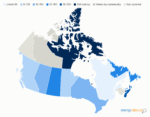
| Province / territory | Rate options | Energy rate (¢/kWh) |
|---|---|---|
| Quebec | Tiered | 7.07 |
| Manitoba | Flat | 9.97 |
| British Columbia | TieredFlatTOD | 11.87 |
| Ontario | TOUTieredULO | 12.0 |
| Alberta | Retail choiceDefault | 12.01 |
| Saskatchewan | Flat | 15.48 |
| Newfoundland and Labrador | By area | 15.59 |
| Prince Edward Island | Tiered | 17.84 |
| Nova Scotia | StandardTOD | 19.13 |
| Nunavut | Subsidized | 74.94 |
| Northwest Territories | Zone rates |
In this article:
- Alberta’s competitive market: fixed-rate, floating-rate, and Rate of Last Resort
- How electricity prices compare across Canada
- Saskatchewan’s regulated rates
- Ontario’s three Regulated Price Plan options
- British Columbia’s tiered, flat-rate, and time-of-day pricing
- Manitoba’s flat residential rate, net-billing credits, and solar rebates
- Quebec’s two-tier Rate D and other Hydro-Québec rate option
- Newfoundland and Labrador’s rates by service area
- Nova Scotia’s standard and Time-of-Day rates
- Prince Edward Island’s tiered electric rates
- Nunavut’s diesel-driven rates
- The Northwest Territories’ zone-rate system
- Our methodology: how we compared rate structures, fixed charges, retail choice, and solar compensation across jurisdictions
From Nova Scotia to Manitoba and all the way to the West Coast, electricity prices vary across the country. Nunavut and the Northwest Territories, for example, face the highest energy costs because of isolated grids, while Quebec and Manitoba utilize hydroelectric resources and have some of Canada’s lowest electricity rates. In contrast, in recent years Alberta, Saskatchewan and Prince Edward Island have experienced some of the higher electricity prices.
For a household consuming 1,000 kWh per month, electricity costs can range from approximately $83 to $375 per month, depending on the province or territory, according to the Canada Energy Regulator. However, no matter the province or territory, actual energy bills depend on several factors including taxes, delivery fees, rate plans, monthly charges and consumption.
At the same time, electricity prices are influenced by fuel sources, provincial policies on the structure of the electricity market, and the cost of generation, transmission, and distribution. Provincial policies and jurisdictions also define how those costs are distributed among residential and commercial customers.
In this guide, we compare residential electricity rates across provinces, available plans, and other options, helping residential customers understand their monthly energy costs and opportunities to save. For a fair comparison, we’ve reviewed regulated rates only for all provinces. However, some provinces, like Alberta and Ontario, may have additional options due to their deregulated markets.
Alberta
As we mentioned in Regulated Rate Plans, Alberta has a deregulated electricity market, in which residential customers can choose between competing electricity retailers and plans potentially saving a significant amount of money in the process. Amongst those plans are fixed rates, floating rates and regulated default options (the Rate of Last Resort).
- Electricity rate and plan types
- Fixed-rate plans lock in an electricity price per kilowatt-hour (kWh) for a specified contract term, commonly one, three, or five years. These plans provide greater price predictability and protect customers from increases in wholesale Alberta electricity prices.
- Floating or variable-rate plans fluctuate with wholesale market conditions. Depending on the retailer, the energy charge may reflect the average pool price over the previous month, or another pricing linked to the wholesale market. While not the most predictable solution, these plans can offer savings when market prices are low but expose customers to price increases during periods of high demand or constrained supply.
- The Rate of Last Resort (RoLR) is the regulated default option for customers who do not choose a competitive retail contract. The rate is established through a regulatory process and applies for a two-year period, providing an alternative to signing a competitive contract.
Competitive fixed- and floating-rate plans in Alberta change based on the retailer (and that’s why energy rate comparison tools like EnergyRates.ca exist). For this article’s provincial comparison, the Rate of Last Resort (RoLR) would be the most comparable plan. Right now, the RoLR is approximately 12.01¢ to 12.06¢/kWh for residential customers, depending on the service area.
- Solar power and micro-generation
- Alberta also operates a net-billing system for customers who generate electricity from renewable sources. Residential solar installations can supply electricity directly to the home, while surplus generation can be exported to the grid for credits.
- Customers with eligible micro-generation systems receive credits for excess electricity according to their retailer’s energy charge or an applicable export-credit program.
- Some solar homeowners also use specialized electricity plans that offer higher export credits during high-production summer months and lower electricity import rates during the winter. Such arrangements can improve the financial return on solar generation, depending on household consumption and the plan’s terms.
Saskatchewan
Although Saskatchewan has a predominantly regulated electricity market, there are three major utilities that supply electricity to the residents: SaskPower, a provincial Crown corporation, supplies electricity to most communities, Saskatoon Light & Power and Swift Current Light & Power serve customers in municipal service areas.
Unlike Alberta’s market, Saskatchewan does not have a broadly competitive residential electricity retail market, and its electricity rates are established through a regulated process.
Residential electricity prices
- SaskPower: 15.476¢/kWh, plus a basic monthly charge.
- Saskatoon Light & Power: approximately 17.02¢/kWh, plus a basic monthly charge.
- Swift Current Light & Power: approximately 17.024¢/kWh, plus a basic monthly charge.
2. Solar and net metering
SaskPower and the two municipal utilities also offer net-metering arrangements for customers who generate their own renewable electricity. For instance, under these programs, eligible customers can export surplus electricity to the grid in exchange for credits.
The supplied research indicates export-credit rates of approximately 7.5¢ to 8.25¢/kWh, depending on the utility. Credits can be carried forward to offset future electricity bills, subject to each provider’s program rules.
Ontario
Ontario’s residential electricity market model delivers electricity to residential and small-business customers under the Regulated Price Plan (RPP), with pricing options established by the Ontario Energy Board (OEB).
Unlike in Alberta, where customers can shop around for best energy rates, most Ontarians are on the RPP and can choose between three main pricing plans:
Each plan uses a different approach to calculating electricity charges, allowing customers to select an option that suits their consumption patterns.
- Residential electricity prices
- Time-of-Use pricing
Under the Time-of-Use plan, electricity prices vary according to the time of day and season.
- Off-peak: 9.1¢/kWh.
- Mid-peak: 14.6¢/kWh.
- On-peak: 18.9¢/kWh.
Off-peak periods include weekends, statutory holidays, and designated lower-demand hours. Mid-peak and on-peak periods generally correspond to times of greater electricity demand.)
This plan can benefit households that can shift energy-intensive activities, such as laundry and dishwashing, to lower-priced periods.
- Tiered pricing
Unlike Time-of-Use pricing, in the Tiered pricing system the cost per kWh does not depend on the time of day. The Tiered plan charges one rate for electricity consumed within a specified usage threshold and a higher rate for consumption above that threshold.
- Tier 1: 11.2¢/kWh for electricity consumed within the applicable monthly threshold. For residential customers, the Tier 1 threshold varies by season and may suit households that prefer predictable pricing throughout the day and do not want to adjust their routines around peak hours.
- Tier 2: 13.2¢/kWh for consumption above that threshold.
- Ultra-Low Overnight pricing
The Ultra-Low Overnight plan offers a discounted rate during overnight hours, alongside higher-priced periods during the day. The plan was designed in part to accommodate electric vehicle charging and other electricity use that can be shifted to late-night hours.
- Ultra-Low Overnight: 3.77¢/kWh, from 11 p.m. to 7 a.m.
- Weekend off-peak: 9.1¢/kWh during designated weekend and statutory holiday hours.
- Mid-peak: 14.6¢/kWh.
- On-peak: 37.7¢/kWh.
The ULO plan can be attractive to electric vehicle owners and households that use substantial amounts of electricity overnight.
- Solar and net metering
Ontario’s net-metering program also allows eligible customers to generate renewable electricity and export surplus power to the grid in exchange for credits on their electricity bills.
Solar customers should account for fixed monthly charges and other costs that remain payable even when their systems substantially reduce electricity purchases.
Ontario increased in 2026 the maximum capacity for micro-embedded generation facilities from 10 kW to 12 kW. However, eligibility and connection requirements still depend on applicable regulations and the local electricity distributor’s requirements. Confirm the rules with the Ontario Energy Board and your distributor before installation.
British Columbia
British Columbia relies primarily on BC Hydro (a provincial Crown corporation), responsible for generating, purchasing, and distributing electricity to most of the province’s population. Additionally, FortisBC supplies electricity in certain regions, while some municipalities operate their own local utilities.
BC Hydro offers residential customers tiered and flat-rate pricing, with optional time-of-day pricing for eligible customers.
- Residential electricity prices
- Tiered pricing
The Tiered plan is BC Hydro’s standard residential option. Just like in Ontario, customers pay a lower rate for electricity consumed within a defined daily threshold and a higher rate for additional consumption.
- Tier 1: approximately 11.87¢/kWh, up to 22.1918 kWh per day.
- Tier 2: 14.08¢/kWh for consumption above the threshold.
- Basic daily charge: 23.44¢.
(This structure can suit households with moderate electricity consumption, including apartments and homes without substantial electric space heating.)
- Flat-rate pricing: 12.70¢/kWh, plus a basic daily charge of 25.00¢.
BC Hydro’s optional Flat Rate plan charges the same price per kWh regardless of total consumption. (This option may appeal to households with higher electricity use that would otherwise pay the higher Tier 2 price for a substantial portion of their consumption.)
- Optional time-of-day pricing: 5¢/kWh credit for electricity used between 11 p.m. and 7 a.m. and a 5¢/kWh surcharge during the 4 p.m. to 9 p.m. peak period. No adjustment applies during the remaining hours.
Eligible customers with communicating smart meters can add time-of-day pricing to their base rate.
This option can reward households that shift electricity-intensive activities, including electric vehicle charging, to overnight hours.
- Solar and self-generation
British Columbia’s solar compensation arrangements vary by utility.
BC Hydro closed its traditional net-metering program to new applications after July 1, 2026, replacing it with a self-generation net-billing arrangement under which eligible customers receive a specified payment for surplus electricity exported to the grid.
FortisBC continues to offer net metering for eligible residential, commercial, and irrigation customers. Its program is designed to help customers offset their electricity consumption with on-site renewable generation, subject to system-size and billing rules.
Note: Because program requirements differ by utility, solar customers should confirm the applicable export rate, capacity limits, and credit-settlement arrangements before investing in a system.
Manitoba
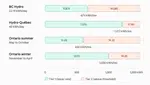
Since Manitoba Hydro supplies most residential customers in Manitoba, there are no competing residential electricity retailers or conventional fixed- and variable-rate retail contracts.
However, Manitoba also has a seasonal residential rate for eligible seasonal properties and certain low-use customers. This rate includes an annual basic charge and a per-kWh energy charge, with bills generally issued twice a year. (A separate diesel-zone residential rate applies in certain remote communities.)
Businesses and other non-residential customers pay general service rates that vary by customer class and may include demand charges.
- Residential electricity pricing
Manitoba Hydro’s standard residential rate consists of a monthly basic charge and a flat charge per kWh consumed. The following rates:
- Energy charge: 9.970¢/kWh.
- Basic monthly charge: $9.84 for service up to 200 amps.
2. Solar and micro-generation
Manitoba uses a net-billing framework for customer micro-generation rather than traditional one-for-one net metering. For example, electricity produced by solar panels first supplies the home or business, reducing the amount purchased from Manitoba Hydro.
As for other programs, Efficiency Manitoba’s Solar Rebate Program offers $0.50 per DC watt up to $5,000 for eligible residential systems up to 10 kW. In the same program, solar equipment is exempt from Manitoba’s 7% provincial sales tax, according to the supplied material. However, program eligibility and rebate availability should be confirmed before installation.
Quebec
Because Quebec benefits from abundant hydroelectric resources, it generally has some of the lowest residential electricity rates in North America. Just like in Manitoba, in Quebec electricity is supplied primarily by the Crown corporation Hydro-Québec, with residential rates subject to provincial regulatory oversight by the Régie de l’énergie.
In Electricity Regulation in Canada per Province, we’ve mentioned that the good news is that Quebec residents pay for one of the lowest electricity rates, thanks to the province’s abundant water resources.
- Residential electricity pricing
Most residential customers are billed under Rate D, which uses a two-tier pricing structure. The following charges, following a 3% increase effective April 1, 2026:
- Daily system access charge: 46.154¢.
- First tier: 7.065¢/kWh for the first 40 kWh consumed per day.
- Second tier: 11.142¢/kWh for electricity consumed above 40 kWh per day.
This structure means that households pay a lower price for electricity consumed within the first daily threshold and a higher price for additional usage.
Hydro-Québec also offers other rate options:
- Rate DP applies to certain residential and farm customers with peak demand of at least 50 kW.
- Rate DM applies to multi-unit residential buildings.
- Rate DN is intended for off-grid systems north of the 53rd parallel.
- Optional programs such as Flex D and the Winter Credit Option provide additional ways for eligible customers to manage electricity use during periods of high winter demand.
- Solar and net metering
Hydro-Québec’s net-metering program allows eligible residential, farm, and business customers with renewable energy systems to export surplus electricity to the grid in exchange for kWh credits. The standard program can accommodate eligible self-generation systems of up to 1 MW, depending on the applicable rate and program requirements.
Customers considering solar should compare the value of exported electricity with the cost of purchasing electricity from the grid and review available provincial incentives. (The LogisVert program is one potential source of financial support for eligible installations.)
Newfoundland and Labrador
Unlike most other provinces, electricity rates in Newfoundland and Labrador vary significantly by service area. While Newfoundland Power distributes electricity to most customers on the island of Newfoundland, Newfoundland and Labrador Hydro supplies electricity in Labrador and serves certain rural island customers.
The province generates most of its electricity from renewable sources, primarily hydroelectricity. However, despite its access to hydroelectricity, the rates customers pay depend on the interconnected system serving their location.
- Residential electricity pricing
The residential electricity rates increased by an average of 2.25% effective July 1, 2026.
- On the Island Interconnected System, L’Anse au Loup, and isolated diesel systems, the standard energy charge is approximately 15.587¢/kWh. Average domestic rates are reported at around 16.7¢/kWh when basic monthly charges are included.
- The Labrador Interconnected System has a substantially lower reported rate of approximately 3.154¢/kWh.
For current rates, consult Newfoundland and Labrador Hydro’s electricity rates page.
- Solar and net metering
Net metering is also available through Newfoundland Power and Newfoundland and Labrador Hydro for eligible customers generating electricity from renewable sources, including solar, wind, and geothermal systems. Customers must also meet equipment and connection requirements, including the use of a bidirectional meter and an isolation switch.
Note: Because utility-specific requirements and system limits apply, customers should confirm the program terms with their electricity provider before installing a renewable-energy system.
Nova Scotia
As the primary electricity utility, Nova Scotia Power provides most of the province’s generation, transmission, and distribution services. Additionally, smaller municipal utilities operate in some communities.
The province’s electricity system uses a mix of conventional generation and renewable energy, where wind power has become an important source of electricity, while provincial policy continues to shape the transition away from coal-fired generation.
- Residential electricity pricing
Nova Scotia Power offers a standard residential rate and alternative pricing options for eligible customers.
- A $20.08 monthly base charge plus an energy charge of 19.128¢/kWh.
(Customers with eligible electric thermal storage or other qualifying heating systems may be able to use a Time-of-Day rate. Under this structure, winter weekday prices vary by period, while weekends and holidays are billed at the off-peak rate.)
The winter weekday rates:
- On-peak: 25.188¢/kWh.
- Mid-peak: 20.263¢/kWh.
- Off-peak: 12.436¢/kWh.
Nova Scotia Power has also offered time-of-use and critical-peak pricing pilots intended to encourage customers to shift electricity use away from periods of high demand. According to the supplied material, applications for these pilots are currently closed.
For current pricing details, visit Nova Scotia Power’s standard residential service rate page.
2. Solar and net metering
Nova Scotia also offers a net-metering program that allows eligible residential and commercial customers to offset electricity consumption with renewable generation, including solar photovoltaic systems.
Under the net-metering program surplus electricity earns credits at the applicable retail rate. Credits carry forward through the calendar year, but unused credits remaining at year-end expire without a cash payout from Nova Scotia Power.
Note: Customers considering solar should review the program’s capacity limits, credit rules, and connection requirements to determine how much of their electricity consumption can be offset.
Prince Edward Island
Prince Edward Island has two main electricity providers: Maritime Electric, which serves most of the province, and Summerside Electric, which serves the City of Summerside. Maritime Electric’s rates are regulated by the Island Regulatory and Appeals Commission (IRAC), while Summerside Electric is generally exempt from IRAC’s rate regulation. Residential customers do not have the same choice of competing retail electricity plans available in Alberta.
- Residential electricity pricing
- For Maritime Electric customers, residential rates effective August 1, 2026, include a service charge of $24.57 per billing period for urban customers and $26.92 for rural customers.
- The energy charge is 17.84¢ per kWh for the first 2,000 kWh per billing period and 14.23¢ per kWh for additional consumption. Seasonal residences have a separate rate classification, although their energy charges follow the same tiered structure.
2. Solar and net metering
PEI also supports residential and commercial solar through net metering. Eligible customers can generate their own electricity and send surplus power to the grid under an agreement with their utility. The province’s Solar Electric Rebate Program offers financial assistance for eligible solar installations, but as of April 15, 2026, applications were paused while funding and program details for the 2026–2027 fiscal year were being finalized.
Nunavut
Nunavut has a regulated electricity market, with Qulliq Energy Corporation (QEC) serving communities across the territory. Unlike provinces with competing electricity retailers, households generally cannot choose between multiple providers or conventional fixed- and variable-rate plans. Electricity rates are regulated, and the cost of supplying power is high because communities rely heavily on local generation, including diesel.
- Residential electricity pricing
- Under the interim rates introduced in April 2025, the residential energy rate for non-government customers was 74.94¢ per kWh.
- Government residential customers had a different rate of $1.13 per kWh. The Nunavut Electricity Subsidy Program helps offset residential costs, including the monthly service charge for eligible non-government residential customers, so the posted rate does not tell the whole story of what every household pays.
2. Solar and net metering
Nunavut also has a net-metering program that allows eligible residential customers to generate electricity from renewable sources, such as solar panels, and send surplus electricity to QEC’s grid in exchange for credits. QEC approval is required before installing a system intended to connect to the grid.
The Northwest Territories
The Northwest Territories has a regulated electricity market, with service provided by utilities including the Northwest Territories Power Corporation (NTPC) and Naka Power Utilities. Customers generally cannot shop among competing electricity retailers. Instead, rates depend on the community and the local power system.
- The territory uses a zone-rate system. Communities supplied by hydroelectricity generally have lower underlying costs than communities that rely on diesel or other thermal generation.
- The Territorial Power Support Program (TPSP) helps residential customers in higher-cost communities pay the Yellowknife rate on a portion of their monthly electricity use: the first 1,000 kWh from September through March, and the first 600 kWh from April through August.
- Rates and adjustments can change by zone. In July 2026, Naka Power Utilities introduced interim rate adjustments while its 2026–2028 general rate application was under review. As a result, customers should check the rate schedule for their specific community rather than rely on one territory-wide price.
Our methodology: How we’ve compared apples to apples
A fair comparison of electricity prices considered the rate structure, fixed monthly charges, delivery costs, and whether customers can choose among competing retail plans. For instance, in Alberta, consumers can compare competitive fixed and floating rates against the regulated Rate of Last Resort. Ontario customers, by contrast, can choose among Time-of-Use, Tiered, and Ultra-Low Overnight pricing under the Regulated Price Plan, although there are some deregulated power options in the province. While similar to Ontario, British Columbia is fully regulated and offers tiered and flat-rate options, with optional time-of-day pricing for eligible customers.
In contrast, Saskatchewan, Manitoba, Quebec, Newfoundland and Labrador, and Nova Scotia primarily rely on regulated utility pricing, although the available rates and programs differ by jurisdiction.
We also compared solar economics that vary by province. While some programs provide one-for-one kWh credits, others compensate exported electricity at a separate rate. In every case, the value of solar generation depends on how much electricity a household consumes directly, the value of surplus power, applicable fees, and available incentives.
When comparing electricity rates by province, we considered (and recommend) using the current tariff for each service area and account for both variable energy charges and fixed fees.
Key takeaways:
- Residential electricity prices vary widely across Canada.
- Quebec and Manitoba have some of the lowest rates in the country because of abundant hydroelectricity.
- The North faces the highest costs because isolated communities rely heavily on diesel.
- Alberta is the only province where residential customers can choose among competing retailers and fixed or floating plans, with the regulated Rate of Last Resort as the default. (Ontario is somewhat deregulated for electricity, but most residents stay under the regulated plans.)
- In Ontario and British Columbia customers can pick a pricing plan, such as time-of-use, tiered, flat, or ultra-low overnight.
- Every province and territory covered offers net metering or net billing for solar. (Some give one-for-one kWh credits, while others pay a separate export rate that’s often below the retail price.)