
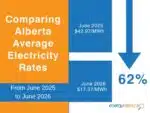
In Alberta, June brought a remarkable shift in the energy market, with wholesale electricity prices falling to levels not seen in the last ten years, since 2016. To have a better view, the average AESO (Alberta Electric System Operator) pool price settled at $17.37/MWh, down more than 62% from June 2025 and the lowest monthly average since April 2016.
However, something our energy experts highlight is that, despite prolonged periods of near-zero pricing, including 179 hours when electricity traded at $0/MWh, the market also experienced a price spike, reaching $738.33/MWh on the evening of June 23, for example. What does it mean? Although quite stable when compared to some years ago, Alberta’s electricity market remains volatile and unpredictable.
The sustained decline in Alberta electricity rates mentioned above was mainly driven by strong generation levels and frequent periods of excess supply, which kept pool prices below $30/MWh for much of June, creating favourable conditions for customers under a floating-rate plan.
However, as we always highlight, before deciding on the most affordable electricity plan, it is essential to look closely at daily behaviour, not just the rates.
As fluctuations persist in Alberta, a Fixed-rate plan can be a financially smart decision for those who don’t follow energy market updates or study scenarios. Such plans allow consumers to fix their rate and are ideal for those who value budget predictability. Although floating rates were incredibly low in June 2026, fixed rates are still much lower than the Rate of Last Resort (RoLR), which is around 12.02 cents/kWh.
Will floating rates continue to stay this low?
It’s hard to predict what future electricity prices will be. One of the best ways to understand trends is to closely watch the energy-related news.
For example, in mid-2026, Meta announced an investment exceeding $13 billion for a new AI data centre in Sturgeon County, while Capital Power continues advancing the Greenlight Electricity Centre, a project expected to support hundreds of megawatts of new demand (932 megawatt gas-fired combined cycle power generation). To support this growth, the AESO has already reserved 1,200 MW of capacity for large industrial loads.
Therefore, while Alberta currently enjoys abundant electricity supply, demand is expected to increase over the coming years. We highlight that the electricity scenario is unpredictable, so it’s hard to forecast what will generate fluctuations. At the end of the day, power rates are determined by the supply and demand rule.
Compare energy rates and save on your energy bills
Just like you shop for other plans when rates are high, low-price markets are also a great opportunity to review your energy options and get a more affordable energy plan. The more you compare energy rates, the higher your chances of securing a good deal.
At EnergyRates.ca, we do the hard work for you. You can compare electricity and natural gas rates in Alberta, The website is 100% free and unbiased and lists the major energy suppliers in the province, as well as their available energy rates.
Whether households or businesses, you can compare energy rates in the form above and find out if you could be paying less on your winter utility bills. Commercial, large commercial and industrial electricity and natural gas consumers can get a free custom quote based on their energy consumption at EnergyRates.ca. All you have to do is go to the form above and start comparing!