

What You Need to Know
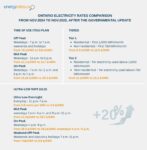
In November 2025, the Ontario Energy Board’s (OEB) updated the electricity rates for residential and small business customers under the Ontario Energy Board’s (OEB) Regulated Price Plan (RPP). According to the Ontario Energy Board report, RPP prices (TOU, ULO, and Tiered) are set annually in November based on a forecast of the cost to supply RPP customers with the electricity they are expected to use over the next 12 months.
Still according to the report, the change in Time-of-Use (TOU) hours and the Tier thresholds pricing for residential customers will remain in place until April 30 of 2026, while Ultra Low (ULO) hours will continue unchanged.
Rates increased by around 20%:
- On-Peak hours of the Time-of-Use plan went from 15.18 ¢/kWh to 20.3 ¢/kWh, comparing Nov.2024 and Nov.2025;
- Tier 1, from the Tiered plan, increased from 9.3 ¢/kWh to 12.0 ¢/kWh comparing the same period;
- And the Ultra Low overnight rate went from 2.8 ¢/kWh to 3.9 ¢/kWh.
Rebate Was Updated with a Focus on Energy Bill Reduction
The Ontario Electricity Rebate (OER) increased from 13.1% to 23.5% the rebate on the electricity bill of residential, small business, and farm customers, appearing as a pre-tax credit at the bottom of electricity bills. For a typical residential customer who uses 700 kWh of electricity per month, the OER will decrease bills by about $36 per month.
Automatic for most customers, the rebate appears on bills as a separate line item. An initiative that will reflect on utilities bills and decrease the impact of the risen rates all over the province for those who qualify for the Ontario Electricity Rebate. Eligible ones include households, farms, long-term care homes, and small businesses.
According to the provincial website, most residential consumers, farms, and many small businesses in Ontario may also receive further reductions on their bill depending on the distribution company, such as: Hydro One (low and medium density customers, Northern Ontario Wires, Chapleau Public Utilities Corporation, Sioux Lookout Hydro, InnPower, Atikokan Hydro, and Algoma Power.
If you’re not sure how to navigate through these increasing rates this winter, check up our article about all three plan options, Time-of-Use (TOU), Tiered, and Ultra-Low (ULO).
Ontario Electricity Subsidy Program
Based on estimates, Ontario spent approximately $6.9 billion in 2021–22 on energy and electricity subsidy programs. Those programs are developed to reduce the electricity bills of Ontario households and businesses and provide subsidies to low- to moderate-income residents.
The amount of subsidy coverage is typically based on household income and household size, with the possibility to also cover reliance on electric heating or certain medical devices. The program does not reduce electricity rates, but rather focuses on providing relief to households and businesses vulnerable to rising energy costs.
However, eligible accounts must be renewed periodically, with credits applied automatically through their electricity utility.
As a part of the same program, the Financial Accountability Office (FAO) of Ontario estimated that in 2021, a typical residential ratepayer’s bill was $121 per month. (This number includes subsidy coverage; without it, the same electricity bill would have been $171 per month.)
As per the province’s electricity subsidy programs, the FAO expects they will provide residential ratepayers with a benefit of $63.9 billion over 20 years. Hence, in 2040 a residential ratepayer’s electricity bill will increase by an annual average of two per cent, from $121 per month to $178 per month. The unsubsidized electricity bill will increase by an annual average of 0.7 per cent, to $194 per month.
These projections demonstrate how the subsidy programs help moderate increases in energy bills but do not change the electricity rate structure itself. Instead of reducing the base cost, they provide targeted relief through rebates, subsidies, and credits.