In this article:
- What is a microgrid
- How do microgrids work and who can benefit from them
- How microgrids improve energy resilience
- How microgrids support sustainability and optimize energy costs
- Canadian microgrid examples: Hartley Bay and Nemiah Valley
When the Government of Canada announced its support for the Lac-Mégantic microgrid, then-Minister of Energy and Natural Resources Jonathan Wilkinson said that the project would “enable the development of a sustainable microgrid while simultaneously developing best practices that can be implemented across Canada.” This statement highlights the potential for microgrids to be adopted more broadly across Canada, given the rising demand for reliable and sustainable electricity.
In the current climate, where provincial governments are trying to meet increasing power needs, microgrids are emerging as an important solution for providing reliable electricity, particularly in remote communities.
There are more than 300 remote communities across Canada, many of which rely on diesel generation and could benefit from renewable energy and microgrid technologies. One of the main focuses of microgrid research is renewable energy generation as a way to reduce reliance on diesel, lower energy costs and improve energy storage, community and Indigenous participation, and energy resilience. Research also examines wind resource assessment and modelling to evaluate the potential for future small-scale wind farms, drawing comparisons with existing on-grid installations.
While Canadian microgrid projects remain on a smaller scale, the global microgrid controller market was estimated at USD $5.216 billion in 2024. According to the Microgrid Controller Market, the industry is projected to grow from USD $5.923 billion in 2025 to USD $21.13 billion by 2035.
However, the microgrid industry is expected to experience significant growth throughout North America, supported by technological innovation and demand for reliable and resilient energy systems.
Get unbiased information
Add EnergyRates.ca as a Preferred Source on Google to see more of our articles in your search results.
Key trends in microgrids:
- Renewable energy integration: The integration of renewable energy sources is growing across North America.
- Advances in control technology: Improvements in microgrid control technologies are designed to increase system efficiency and reliability.
- Strong off-grid growth: While grid-connected systems continue to account for the largest share of the market, the off-grid segment is expanding as energy demand rises in remote and underserved areas.
- Energy storage and policy support: The integration of energy storage systems, combined with clean-energy initiatives, is helping accelerate investment and market expansion.
As microgrids continue to play an important role in delivering energy services, these systems can help support expanding energy access, help balance variable wind and solar generation, strengthen grid reliability and reduce greenhouse gas emissions.
The growth of microgrids is being driven by several factors, including:
- Rising and increasingly volatile electricity costs
- The need to accelerate global decarbonization
- Growing demand for greater energy independence
- Advances in technology that are making microgrids more efficient and cost-effective
What is a microgrid?
A microgrid is an electric system that operates either while connected to the main utility grid or independently within a defined local area. The relatively small size and flexibility of microgrids allow residential and commercial energy customers to generate and manage electricity while maintaining access to the wider grid.
Microgrids integrate distributed energy resources (DERs), such as solar panels, wind turbines, and battery storage. The main purpose of microgrids is to help manage energy use and reduce electricity costs. Because microgrids operate in both grid-connected and remote settings, excess electricity can be supplied back to the grid where permitted, while stored or locally generated power can help meet demand during peak periods. This can improve energy resilience, optimize electricity use and reduce reliance on the grid.
How do microgrids work?
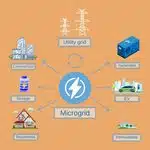
Microgrids utilize local electricity generation, energy storage, electricity loads, and control systems to create a local energy network. They can operate while connected to the main utility grid or disconnect and function independently when needed. A microgrid controller continuously monitors electricity generation, storage and demand, directing power where it is needed and helping optimize the use of locally generated energy.
- Local generation: Solar panels, wind turbines and natural gas generators generate electricity locally.
- Energy storage: Batteries can store excess electricity for future use when generation is low or demand is high.
- Energy management: A microgrid controller monitors generation, storage and electricity demand, adjusting the flow of power accordingly.
- Grid connection: A microgrid can draw electricity when needed and send excess generation back to the grid where permitted.
- Island mode: The microgrid can disconnect from the main grid and continue supplying power to connected loads using its local resources during a grid outage or other disruption.
Do microgrids improve energy resilience?
Microgrids can provide access to electricity when the main grid is disrupted due to severe weather, power outages or equipment failures. When critical facilities need to remain open regardless of grid conditions, microgrid controllers can detect an interruption and switch to on-site generation or utilize stored energy.
In short, microgrids improve energy resilience by allowing electricity users to continue operating even when the main power grid experiences an outage by combining local generation, energy storage and intelligent controls.
- Backup power: Local solar, wind, natural gas, or diesel generation can provide electricity when grid service is interrupted.
- Energy storage: Batteries can store electricity and provide backup power when generation is unavailable.
- Island mode: A microgrid can disconnect from the main grid during an outage and operate independently, keeping critical loads powered.
- Reduced outage impacts: Hospitals, emergency services, businesses and remote communities can keep operating instead of waiting for utility service to return.
- Energy flexibility: By generating and managing electricity locally, microgrids reduce dependence on a single centralized power system.
Who can benefit from microgrids?
Although microgrids are particularly relevant to remote communities, they can serve a wide range of facilities that require a highly reliable power supply. Overall, off-grid and remote communities looking to reduce their reliance on diesel generation can also benefit from microgrids.
The primary reasons for considering a microgrid are to improve the resilience of an energy system, reduce energy costs, and increase renewable energy use. After an organization evaluates its electricity demand, utility rates, available incentives and existing generation and storage, it can use a financial assessment to determine the potential costs and benefits of a microgrid.
An organization or community that wants greater control over its energy use or is looking to integrate renewable energy and battery storage may benefit from a microgrid, particularly if it operates in a location where power interruptions can be costly or access to the main grid is limited. These organizations include:
- Healthcare facilities
- Educational institutions
- Municipalities and communities
- Industrial and commercial facilities
- Emergency facilities
- Remote and off-grid communities
Do microgrids support sustainability?
Microgrids allow organizations to increase their use of renewable energy by providing a framework for incorporating energy storage and renewable energy into local electricity systems. In some microgrids, solar, wind and battery storage are combined with existing generation, which helps maintain a reliable power supply. In other cases, locally generated electricity can be exported to the utility grid, helping support the broader grid and reduce carbon emissions.
How much does a microgrid cost?
The cost of microgrids depends on several factors, such as energy sources, storage capacity, system size, control technology, and site requirements. While there is no standard price for a microgrid, projects can be financed through capital expenditure (CapEx) or operating expenditure (OpEx) arrangements. Local regulations and utility requirements can also influence the overall cost.
How can microgrids optimize energy costs?
Because microgrid intelligent control systems can respond to weather conditions and changes in electricity demand, they can also help organizations manage electricity costs. If an organization relies on on-site generation or battery storage during periods of high electricity prices, it can draw energy from the grid when prices are lower. Additionally, excess generation or stored electricity could be used for demand response and, where regulations allow, exported to the grid.
What are distributed energy resources (DERs)?
Distributed energy resources (DERs) are local electricity generation and storage resources located close to where energy is consumed rather than at a centralized power plant. DERs can include solar panels, wind turbines, batteries, controllable loads and other forms of distributed generation and storage. In a microgrid, a controller coordinates these resources and manages the system’s connection to or disconnection from the main grid, helping provide renewable generation, flexibility and reliable integration with the utility system.
Can microgrids optimize electricity rates?
One of the potential benefits of microgrids is reducing electricity costs by optimizing when energy is generated, stored, and used. When electricity demand is high, the microgrid system can utilize stored energy instead of drawing power from the grid. Organizations may also be able to provide excess electricity or reduce their grid consumption in exchange for financial compensation through demand-response programs, allowing them to lower operating costs while helping utilities manage pressure on the grid.
Examples of microgrids in Canada:
As a remote and off-grid coastal community of approximately 170 residents, Hartley Bay has historically relied on three diesel generators, with electricity costs reaching about $0.67 per kWh.
The smart microgrid this community relies on combines energy monitoring and demand management, which makes diesel generation more efficient. Monitoring the performance of the community’s three generators helped identify opportunities to reduce fuel consumption. The two 420 kW generators were found to operate more efficiently than the smaller 210 kW generator, so the community adjusted its generator’s dispatch to minimize use of the less-efficient unit. Through changes to generator operation, the community reduced diesel consumption by an estimated 77,000 litres per year, saving approximately $77,000.
The community’s smart microgrid combines real-time energy monitoring with demand management and improved diesel generator operation. Wireless smart meters allow electricity demand to be monitored throughout the community, while an energy management information system tracks consumption in real time. Hartley Bay has also upgraded lighting, heating and HVAC systems and hired local energy coordinators to oversee energy projects and work with residents.
The project also demonstrates how real-time energy monitoring and community involvement can improve efficiency and reduce emissions in remote communities.
Another example of an active microgrid is the Nemiah Valley Renewable Microgrid. The Xeni Gwet’in First Nation’s off-grid community in British Columbia has a renewable microgrid that combines 250 kW of solar photovoltaic (PV) generation with 1 MWh of lithium-ion battery storage, integrated with existing diesel generators. Although historically the community relied on diesel and propane generation, the microgrid system, which began operating in November 2022, integrated solar and battery storage to help reduce fuel consumption and energy costs. In addition to reducing greenhouse gas emissions, the project has the potential to serve as a model for similar renewable-energy projects in remote off-grid communities.
Key takeaways:
- Microgrids are localized energy systems that can operate independently or alongside the main electricity grid.
- Microgrids combine local generation, energy storage, demand management, and control technologies.
- Microgrids can help organizations manage electricity costs, reduce peak demand, and make better use of renewable energy.
- Remote and off-grid communities can use microgrid technologies to reduce reliance on diesel generation and lower fuel consumption, along with energy costs.
- Canadian projects such as Hartley Bay demonstrate how real-time monitoring, demand response and improved generator management can reduce fuel use and operating costs.